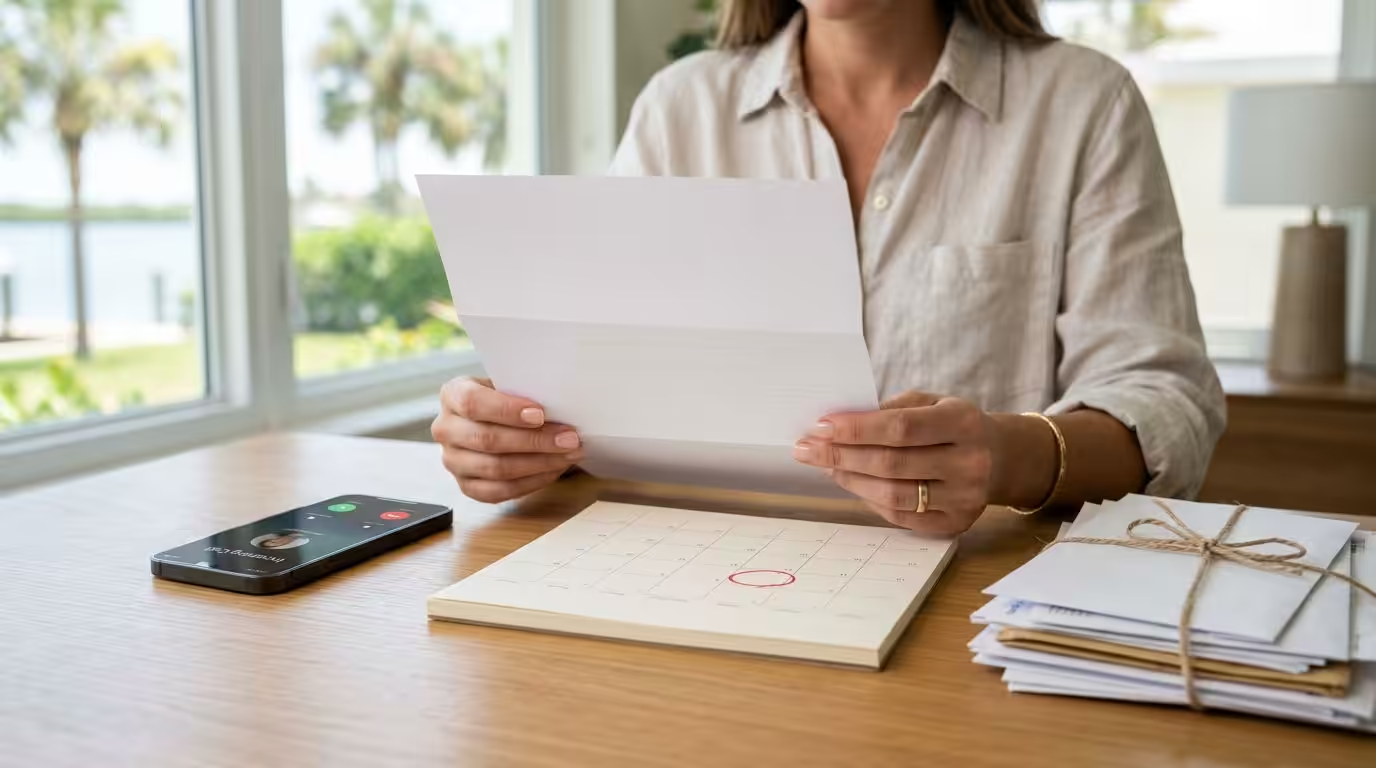

You open a collection letter at your Pinellas County kitchen table, worried that paying immediately is your only option. A timely dispute in writing can trigger debt validation rights and require the collector to pause collection until it mails the required information.
I’m Michael Ziegler, a Clearwater consumer-debt attorney licensed in Florida since 2010. For Florida debt validation, start by saving the notice, recording when it arrived, and sending your dispute before the deadline.

What a Florida debt validation notice must tell you
The federal Fair Debt Collection Practices Act, or FDCPA, covers consumer debts such as credit cards, medical bills, and personal loans. It generally applies to a third-party debt collector, including qualifying debt buyers and collection attorneys, rather than original creditors.
The collector’s five-day deadline
Under 15 U.S.C. § 1692g(a), a collector must send validation information within five days after its initial communication. A separate notice isn’t required if the first communication already contains the required information or you’ve paid the debt.
That first contact could be a telephone conversation. A formal court complaint, however, doesn’t count as the initial communication for this requirement.
The information you should receive
The notice must identify the amount owed and the current creditor. It must explain your right to dispute within 30 days and request the original creditor’s name and address.
The Consumer Financial Protection Bureau (CFPB) provides details on the CFPB’s validation notice requirements, including itemization information and a stated validation-period end date. These Regulation F requirements took effect November 30, 2021.
The CFPB provides a model notice, but collectors don’t have to use that exact form. Whatever format they choose, the required disclosures still matter.
Count the 30 days from receipt
Your statutory dispute period runs 30 days after you receive the notice, not after the date printed on it.
For example, if you receive a notice on October 7, 2026, the 30-day period ends November 6. Save the envelope and record the delivery date. I want those dates documented before you discuss payment.
Regulation F allows collectors to calculate presumed receipt using a five-day delivery period that excludes Saturdays, Sundays, and federal holidays. That delivery calculation is different from your 30-calendar-day response period.
Don’t wait until the last day. Send your dispute promptly and keep proof of when you sent it.
Collectors aren’t automatically required to pause collection activity during the full 30-day period. The pause follows a timely written dispute or written request for original-creditor information.
Missing the deadline doesn’t mean you’ve admitted owing the money. Under 15 U.S.C. § 1692g(c), silence cannot be treated as an admission of liability. You can still challenge the debt, although the automatic validation-related collection pause no longer follows from an untimely request.
Send a short written dispute, with proof
You don’t need to explain your finances or promise a payment. Identify the account and clearly state what you dispute.
What to put in your letter
Include your name, mailing address, the collector’s account reference, and the date. A debt validation letter can be brief: identify the account and state what you dispute. If you dispute the whole debt, straightforward wording works:
I dispute this debt in full. Please provide verification under 15 U.S.C. § 1692g(b). Please also provide the original creditor’s name and address if different from the current creditor. Stop collection until you obtain and mail the information required by law.
This written debt validation request tells the collector you dispute the account and asks it to pause collection until it mails the required information.
If only part of the balance is wrong, identify that portion. A dispute can address an incorrect balance, mistaken identity, prior payment, or another genuine disagreement.
I recommend keeping the explanation focused. Don’t include your full Social Security number, banking credentials, or unnecessary personal records.
Keep a complete delivery record
Use the dispute address provided in the notice. Certified mail with return receipt provides useful evidence, although the FDCPA doesn’t require that mailing method. Keep the signed letter, mailing receipt, tracking information, and response.
A written electronic dispute can also work through a channel the collector accepts for disputes. Save the submission and confirmation.
An oral dispute doesn’t trigger § 1692g(b)’s verification-related collection pause. It can still establish that you dispute the account for other purposes, including disputed-debt reporting. Put the request in writing to preserve the stronger protection.
If a collector keeps calling after your written dispute, call (727) 538-4188 or book a Free Debt Freedom Strategy Session (a free consultation with an attorney).
What verification does, and doesn’t, prove
After receiving your timely letter disputing the debt, the collector must stop collecting it until it obtains supporting information and mails its debt verification to you. A timely written request for the original creditor’s name and address triggers a similar pause until the collector mails that information.
The FDCPA’s validation provisions don’t give collectors a separate 30-day deadline to answer. They can leave the account inactive rather than respond.
The law also doesn’t automatically require an original signed contract or every document needed to win a lawsuit.
In Chaudhry v. Gallerizzo, 174 F.3d 394 (4th Cir. 1999), the court described a limited verification standard: written confirmation that the amount demanded matches what the creditor claims is owed. That Fourth Circuit decision isn’t binding on Florida’s federal courts.
I wouldn’t treat a verification letter as a court ruling. You can still dispute ownership, payment history, identity, or enforceability.
A validation request also differs from a written request to cease and desist communications under § 1692c(c). That request generally restricts further communications, subject to limited exceptions. Neither request cancels the debt or prevents an otherwise lawful lawsuit.
What Florida’s FCCPA adds
Florida debt collection laws include the Florida Consumer Collection Practices Act, found at Fla. Stat. §§ 559.55 through 559.785. It supplements federal protections and adds consumer rights. Under § 559.552, the more protective provision controls when state and federal protections conflict.
Original creditors must follow Florida’s rules
The FCCPA reaches original creditors as well as third-party collectors. Your credit card issuer or medical provider doesn’t escape Florida’s collection restrictions simply because it owns the account.
Under Fla. Stat. § 559.72, prohibited conduct includes harassment or abuse, false or misleading representations about legal authority, and publishing “deadbeat lists.” Employer communications before final judgment are restricted, with statutory exceptions such as written permission.
Calls between 9 p.m. and 8 a.m. in your time zone require prior consent. The current statute contains an exception for otherwise compliant emails.
The FCCPA doesn’t automatically give every original-creditor account the FDCPA’s validation procedure. I separate those questions: who contacted you, what they sent, and what they did afterward.
Registration doesn’t apply to everyone
Florida consumer collection agencies generally must register with the Office of Financial Regulation and renew between October 1 and December 31 annually. Exemptions include certain original creditors, financial institutions, and attorneys.
Registration and lawful conduct are separate issues. An exemption doesn’t authorize harassment.
Florida courts give due consideration and great weight to federal FDCPA interpretations under § 559.77(5), but the two statutes aren’t identical.
Keep lawsuits and old-debt deadlines separate
A validation letter doesn’t replace a court response. If you’ve been served, read the summons immediately.
An ordinary Florida civil lawsuit generally requires a response within 20 days after service. Small-claims papers can instead direct you to a pretrial conference. Ignoring those instructions can lead to a default judgment, even when you dispute the debt.
Our Florida debt collection lawsuit defense service addresses that court process separately from validation. In our Clearwater office, I treat the court deadline as a separate priority, never something a dispute letter handles for you.
The debt’s age raises a separate Florida debt statute of limitations question. Under Fla. Stat. § 95.11, written-contract claims generally have a five-year limitation period. Oral-contract and open-account claims generally have four years. An “open-ended” credit account doesn’t automatically receive five years; the contract and claim matter.
Regulation F prohibits covered collectors from suing or threatening to sue over time-barred debt. An expired lawsuit deadline doesn’t automatically erase the balance.
Validation also doesn’t automatically remove an account from your credit report. Our explanation of disputed debt credit reporting addresses that separate process.
If collection continues, save the evidence
After a timely written dispute, save any payment demands, calls, or texts from the debt collector made before the required information is mailed. Keep the original notice, any debt verification, your dispute, delivery proof, and a dated contact log.
I want the actual letter and exact wording, not just a summary of what frightened you. The details decide whether a violation occurred.
You can submit complaints to the CFPB and Florida Attorney General. Registration concerns belong with Florida’s Office of Financial Regulation. Complaints don’t extend court deadlines or the time to bring your own claim.
Under 15 U.S.C. § 1692k, an individual FDCPA action allows actual damages, up to $1,000 in additional statutory damages, and reasonable attorney’s fees and costs. The $1,000 cap is generally per lawsuit, not per violation.
FCCPA remedies under § 559.77 include actual damages and up to $1,000 in additional statutory damages. FDCPA claims generally must be filed within one year; FCCPA claims have a two-year deadline. Our guide to Florida debt collection claim deadlines explains how those clocks run.
Collectors can raise a bona fide error defense, but must prove an unintentional error despite procedures reasonably designed to prevent it. Saying “we made a mistake” isn’t enough.
We handle FDCPA and FCCPA claims on contingency. In a successful case, the law allows the court to order the violator to pay reasonable attorney’s fees on top of your recovery.
Frequently Asked Questions
When does the 30-day debt validation period start?
The period runs for 30 days after you receive the notice, not from the date printed on it. Save the envelope and record when it arrived.
Does a debt validation letter stop collection calls and letters?
A timely written dispute requires the collector to pause collection until it obtains supporting information and mails verification to you. A validation request doesn’t cancel the debt or prevent an otherwise lawful lawsuit.
Does verification prove that I owe the debt?
No. Verification doesn’t decide whether you owe the debt or require the collector to provide an original signed contract or every document needed to win a lawsuit. You can still dispute ownership, payment history, identity, or enforceability.
Does Florida’s debt collection law cover original creditors?
Yes. The Florida Consumer Collection Practices Act applies to original creditors as well as third-party collectors, but it doesn’t automatically give every original-creditor account the FDCPA’s validation procedure.
Do I still need to respond to a lawsuit after sending a validation letter?
Yes. A validation letter doesn’t replace a court response, and an ordinary Florida civil lawsuit generally requires a response within 20 days after service. Follow the instructions and deadline in the court papers.
Protect your deadline before discussing payment
Save the notice and send your letter while the validation window remains open. If court papers arrived too, protect that separate deadline.
Call Ziegler Diamond Law at (727) 538-4188 for a Free Debt Freedom Strategy Session. You can also schedule a Free Debt Freedom Strategy Session online.
By Michael A. Ziegler, Esq., Florida Bar No. 74864, Managing Partner, Ziegler Diamond Law, Clearwater, FL
This article is general information, not legal advice. For Florida residents, contact Ziegler Diamond Law for a Free Debt Freedom Strategy Session.